 |
| Microsoft excel |
Question
1).
What is Microsoft excel used for?
Answer: Excel
is an impressive magical tool to calculate any data whether is small or
big. It has many features to handle the database in numbers and for text
content as well.
Let's do a small practice like if we have small data or
content to put in an excel sheet to calculate or work on, though it provides
cells, rows, and columns to add more & more information in it as per our
requirements.
Here we can see an image of what the same how does look
like.
Once we open an MS excel it shows so many cells and rows,
after seeing it we might get excited or confused as well like how we going to
use it but there is nothing to worry about it.
Let’s learn the basics first about it so we will not get any
issues while we work on it because if we get complete knowledge about it, we
can enjoy working on it rather than be disturbed.

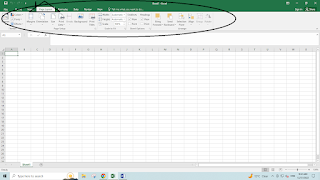
So let s first its interface below in an image.

This picture clearly shows some tabs at just the top of the image. This image that we can see above it has some tabs and we can see these tabs mentioned with names below to quite understand what exactly they are.
1). FILE
2). HOME
3). INSERT
4). PAGE LAYOUT
5). FORMULAS
6). DATA
7). REVIEW
8). VIEW
Now here we have to understand that it depends on us like
how many tabs we want in total however currently we can see that we have eight
tabs above in the image. We can make or add more tabs through the developer tab.
At this moment, let us check another page below for better and good learning.
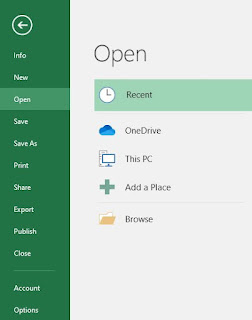
2ndstep is now we see again some options in the image above that we have here.
1). INFO
2). SAVE
3). SAVE US
4). PRINT
5). SHARE
6). EXPORT
7). PUBLISH
8). CLOSE
9). ACCOUNT
9). OPTIONS
On the right-hand side, we see these options below in the image

1). RECENT
2). OneDrive
3). This PC
4). Add a Place
5). Browse
The fourth step is straightforward here, let's see an image below for
the same.

This sheet has more than 1 million cells or rows, which is quite good or impressive, and we need to appreciate Microsoft for making such a helpful tool for users.
In the excel sheet in left side corner, we can see here we have
numbers that start from 1stto 1048576 and on top, it starts in alphabets
from “A” to “XFD”
That is a basic thing about an excel sheet now if we want to add any data to the sheet, we have columns and rows in it and can customize it.
If we want to create a workbook or excel then we can do this below that we did below.
HOME

In the HOME tab, we have these many options that we can use to customize our data as per our needs. we can put our data in colour and filters or whatever we want from this HOME tab and can apply these settings to make our data better to understand and attractive too.
INSERT
We will learn here few things from this tab, which is quite simple and lovely to know.

PAGE LAYOUT
In-Page Layout
We have several options or features to use, Print command also comes under this Page Layout tab and that is also important because sometimes we need to take a print of the workbook so in that case, we can use it.
FORMULAS
In formulas, we have some functions for basically financial, text, logic, math, etc. Let’s check the image below.

DATA
In the same way, we can see the next tab named DATA and
which has many functions to use like finding duplicate values etc.

REVIEW
In this tab, we get these features as mentioned below in the image. Once we going to start working on these options, we will get to know the importance of these features and understand them too.

VIEW
In this tab, we have some features like page break and zoom options and the most important is Macros. Macro is one of the most powerful tools in MS excel and how do we use it, let s understand that now but first we see these options in the image below.

Macro:-
This
tool we use to make our work burden as slow as. If we do any repeated task
in excel again and again then we can use this tool to record the session of the excel workbook and play it. It will complete the job, as we need as per our choice. It
works well and it’s very helpful when we have too many repeating tasks to handle
in an excel workbook.
Though we have more to learn so lets discuss what we can learn from it
Basic Functions and Formulas: Data manipulation and analysis require an understanding of basic formula writing as well as fundamental functions like SUM, AVERAGE, MAX, and MIN.
Data formatting: You may improve the readability and visual appeal of your spreadsheets by learning how to properly format cells, rows, and columns.
Data Validation: By putting data
validation rules into practice, errors are decreased and data accuracy is
ensured by making sure that the data entered into cells satisfies predetermined
requirements.
Conditional Formatting: This technique makes it simpler to spot trends and outliers in your data by enabling you to dynamically format cells according to predetermined criteria.
Advanced Functions: For more complex data manipulation and analysis, functions like IF statements, nested functions, VLOOKUP, HLOOKUP, INDEX-MATCH, and others are frequently utilized.
Data Analysis Tools: For carrying out intricate what-if analyses and optimization, Excel comes with built-in data analysis tools like Goal Seek, Solver, and Scenario Manager.
What-If analysis with data tables: Data tables let you investigate various situations by changing input values and seeing how those changes affect the output values.
Macros and Visual Basic for Applications (VBA): These two tools let you personalize Excel's features and automate tedious operations. Your productivity can skyrocket if you can create and run macros.
Data Import and Export: Working with a variety of datasets requires the ability to import data from outside sources and export data to different forms (such as CSV or text files).
Excel provides tools for recording changes, sharing workbooks, and
password-protecting worksheets and workbooks in order to facilitate
collaboration with others.
Database Functions: To execute computations on data contained in Excel tables or external databases, Excel has database functions including DSUM, DCOUNT, DAVERAGE, and DGET.
Excel Tips and Tricks: You may work more quickly and effectively in Excel by learning different shortcuts, productivity tactics, and tips and tricks.
Data Transformation and Cleaning: Two crucial processes in getting data ready for analysis are transformation and cleaning. Excel has functions for data transformation, duplication removal, filtering, and sorting.
Using Power Query for Data Analysis: Power Query is an effective tool for integrating, cleaning, and transforming data. Your data preparation process can be streamlined by becoming proficient with Power Query.
Power Pivot for Data Analysis: With Power Pivot, you can use big datasets to do sophisticated data analysis and build data models. Gaining knowledge of Power Pivot will enable you to create reports and analyses that are more complex.
Excel Tables: Excel tables offer a methodical approach to data organization and analysis. Sorting, filtering, and referencing data are just a few of the chores that may be made easier with an understanding of Excel tables.
Array formulae: Using array
formulae, you may compute on data arrays. Gaining proficiency with array
formulae will enable you to use Excel for sophisticated computations and
problem-solving.
Excel's latest feature, dynamic arrays, lets formulas automatically spill over neighboring cells and produce multiple values. Comprehending dynamic arrays can enhance spreadsheet productivity by making formula writing simpler.
Excel Add-ins: By adding new features and tools, Excel add-ins increase the usefulness of Excel. Gaining proficiency in installing and utilizing Excel add-ins will increase your productivity and broaden Excel's features.
Techniques for Data Visualization:
Excel has a number of tools for data visualization, such as extensive chart
customisation choices, conditional formatting icons, and sparklines. You can
convey findings more effectively if you know how to visualize data well.
Financial analysis tasks including financial modeling, valuation, and investment analysis are frequently performed in Excel. Acquiring the skill of using Excel for financial analysis might lead to career chances in finance.
Excel for Project Management: Gantt chart generation, resource planning, and task tracking are just a few of the project management responsibilities that Excel can handle. You can handle jobs and projects more skillfully if you know how to utilize Excel for project management.
Statistical Analysis with Excel:
Excel comes with tools and built-in statistical functions to help with basic
statistical analysis. Acquiring proficiency in Excel for statistical analysis
can prove beneficial in domains including quality assurance, data science, and
research.
Excel for Business Intelligence (BI): Excel is a useful tool for business intelligence tasks like dashboard design, interactive reporting, and data visualization. Businesses can utilize Excel for BI to get insights from their data and make wise decisions by knowing how to use it.
Excel for Academic and Educational Objectives: Excel is frequently used for tasks like data analysis, modeling, and classroom exercises in academic and educational environments. Learning Excel may help researchers, teachers, and students in a variety of professions.
These extra topics offer a more thorough grasp of the several uses for Excel by delving further into particular aspects of its functionality and application.
Microsoft
Excel is like magic power that we got from Microsoft INC.
We can learn more about it and can learn all these basic functions practically. Many people are teaching MS excel online and offline and on YouTube and anyone can take free classes on YouTube.
Some
of them are providing paid classes also but this different thing so if anyone
wants to learn for free, they can also do it from YouTube.


